 EN
 DE

Location data as the basis for responsible decision-making
What lies hidden in the soil, groundwater or surface water can be crucial to the safe and sustainable development of a site. A robust site assessment provides clarity on potential contamination, helps to classify risks and enables the next steps to be planned on a sound basis.
For responsible environmental and land management, it is not enough to consider individual pieces of information in isolation. What is crucial is a structured investigation process that combines sampling, analysis, expert assessment and transparent documentation.
ICP Ingenieurgesellschaft – Part of SIERA – supports environmental site investigations and contaminant assessments through systematic analyses of soil, groundwater and surface water. This provides a reliable data basis for environmental assessments, the remediation of contaminated sites and regulatory processes.
Early detection, professional assessment, targeted action
Identifying potential contamination at an early stage is essential for making sound decisions. Investigations provide the information needed to assess risks objectively and prepare appropriate measures.
An environmental site assessment can provide answers to a range of questions:
- Which substances are present in the soil, groundwater or surface water?
- Where might the main areas of stress lie?
- What risks need to be taken into account in the subsequent planning or refurbishment process?
- What further tests or measures are required?
- What information is required for environmental assessments or regulatory procedures?
The results do not in themselves constitute a decision. However, they provide a transparent basis on which those responsible can make technically sound plans for the future use, development or remediation of a site.
Systematic investigations of soil and water
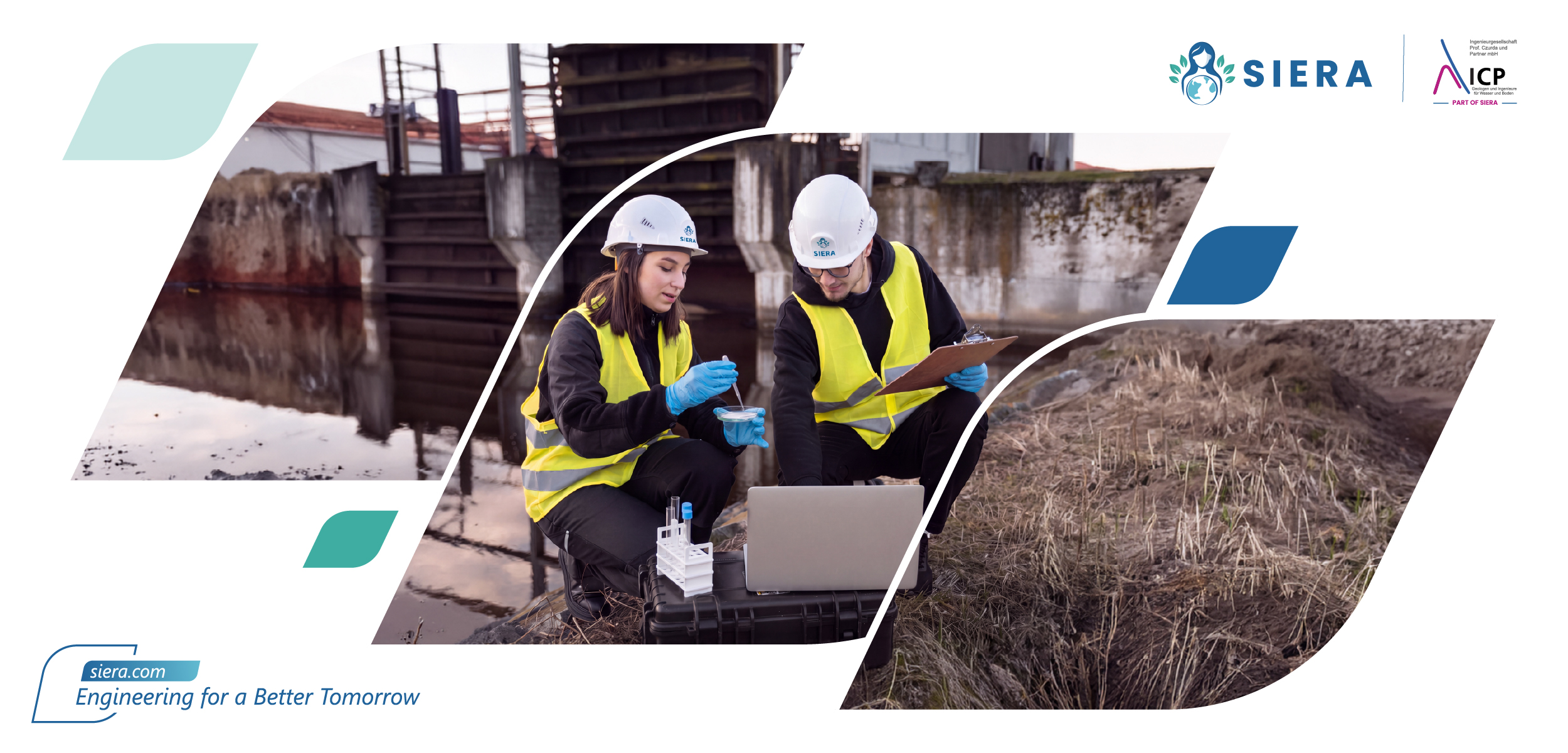
The quality of a site assessment depends largely on structured data collection. To this end, sampling and analysis of soil, groundwater and surface water are carefully planned and carried out.
ICP Ingenieurgesellschaft within SIERA supports these processes by combining fieldwork, laboratory coordination and technical analysis. The individual stages of the work are interlinked:
| Step | Contribution to the site assessment |
| Systematic sampling | Collection of relevant information from soil, groundwater and surface water |
| Field studies | Assessment of the situation directly on site |
| Laboratory Coordination | Analysis of the samples taken for relevant substances |
| Technical evaluation | Assessment of the test results and evaluation of potential risks |
| Documentation and reports | A transparent basis for planning, environmental assessments and regulatory processes |
This structured approach helps not only to collect data, but also to place it in a technical context. In this way, individual survey results can form a sound basis for the further management of a site.
Assessing pollutants – including PFAS-related substances
The identification and assessment of pollutants is a key component of environmental site investigations. Depending on the site, its history of use and the specific issues under consideration, different groups of substances may be relevant.
The investigations also take PFAS-related substances into account. Assessing these substances requires a careful examination of the available data and a clear contextualisation within the respective investigative and planning framework.
The technical assessment provides a clear overview of potential risks. This helps clients to better understand the risks and to prepare for the next steps in a targeted manner – for example, as part of an environmental assessment, land development or the remediation of contaminated sites.
Coordinate screening programmes in a targeted manner
Complex sites often require more than a single survey. To ensure that the data obtained is meaningful and can be put to good use, survey programmes must be planned and co-ordinated in a structured manner.
ICP Ingenieurgesellschaft together with SIERA supports the coordination of such environmental research programmes. The aim is to take the relevant issues into account, to coordinate the research effectively and to present the results in a clear and comprehensible manner.
A coordinated approach offers significant advantages:
- Clarity regarding the need for investigation
Data collection is tailored to the specific requirements of the site. - Reliable bases for decision-making
Results from soil, groundwater and surface water analyses are collated by experts. - Transparent documentation
Structured analysis reports make results and assessments transparent. - Support for other processes
The data can be used as a basis for environmental assessments, the remediation of contaminated sites and regulatory processes.
Transparency in land-use planning and environmental protection
Reliable site data ensures that decisions are based not on assumptions but on verifiable information. This is particularly important when sites are to be further developed, valued or redeveloped.
By combining sampling, field investigations, laboratory coordination, contamination assessment and structured documentation, we support ICP Ingenieurgesellschaft – Part of SIERA – a responsible approach to environmental and land management.
This lays the foundations for greater planning certainty, identifies risks at an early stage and enables existing pressures to be addressed in a targeted manner.
CTA
Find out more about the services offered by ICP Ingenieurgesellschaft – Part of SIERA – in environmental site investigations, contamination assessment and the remediation of contaminated sites: ICP Ingenieurgesellschaft
Engineering for a Better Tomorrow