 EN
EN  DE
DE 
Modern road infrastructure must be able to withstand increasing traffic volumes, changing climatic conditions and long-term structural requirements. To meet these challenges, every successful road construction project must begin with a clear understanding of the ground conditions. This is precisely why ground investigations are such a crucial part of the planning process.
Site investigations provide the geotechnical and waste management information required to assess subsoil conditions, groundwater influences, the suitability of materials and potential risks. These findings form the basis for sound planning, robust tender documents and technically sound construction decisions. Without precise knowledge of subsoil conditions, road construction projects can face significant structural, scheduling and financial consequences.
At ICP Ingenieure GmbH – part of SIERA This work forms part of a broader endeavour to lay resilient foundations for a safe and reliable infrastructure. ICP Engineers has been since 1992 operates in this field and combines geological and geotechnical expertise with a strong focus on sustainable engineering and long-term ecological balance.
SIERA combines environmental expertise, responsible investment and strategic partnerships to achieve measurable impact. By bringing together engineering firms, investors and innovation partners, it transforms SIERA Turning sustainable ideas into practical solutions to environmental challenges – through collaboration, technical excellence and concrete implementation in practice.
Why ground investigations are so important in road construction
Roads are only as durable as the ground on which they are built. A professional ground investigation helps engineers and project managers to make well-informed decisions at an early stage.
The key benefits include:
- the design of a frost-resistant road structure
- determining whether land improvement measures are necessary
- the identification of unfavourable groundwater conditions
- the assessment of the reusability or disposal requirements of excavated materials
- the reduction of construction risks and the avoidance of costly surprises during the execution of the works
Without these investigations, it is not possible to reliably ensure the long-term durability and serviceability of a road.
The key components of a ground investigation
- Site work and on-site surveys
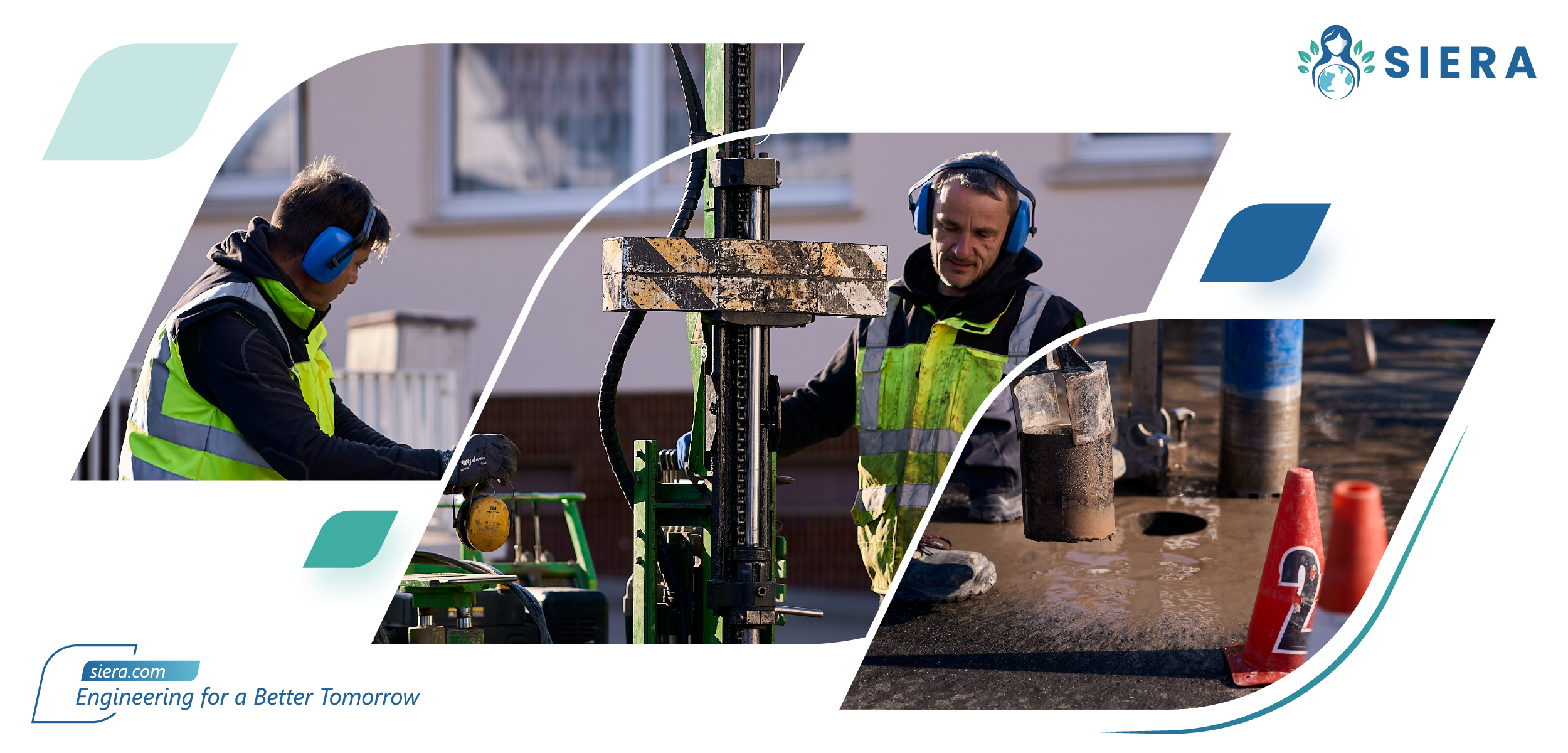
A ground investigation begins long before any drilling or sampling takes place. First, plans showing the layout of existing utility lines must be obtained and checked. Existing utility lines are then mapped using field surveys, and the investigation points are determined accordingly.
The fieldwork itself may include the following:
- Core drilling through existing paved surfaces
- Hand-dug excavation pits
- Dynamic probing with liner samples
- Geotechnical recording of the subsoil profile
- Sampling for geotechnical and environmental investigations
These investigations are carried out on site in accordance with the necessary traffic safety measures and technical requirements.
This approach reflects the performance profile of ICP Engineers with a clear focus on survey methods, sustainable investigation techniques, modern equipment and project-specific approaches tailored to the respective requirements.
2. Laboratory tests on soil mechanics
Following sampling in the field, laboratory tests provide the data required to assess the engineering behaviour and suitability of the materials.
Typical investigations include:
- Grain size distribution by wet sieving in accordance with DIN EN 933 / TP Gestein-StB
- Proctor test in accordance with DIN 18127 or DIN EN 13286-2
ICP Engineers refers to the Soil mechanics is also a key area of expertise. This includes standard soil mechanics tests, further investigations into soil behaviour, the determination of soil parameters and consistency limits, as well as classification and suitability tests.
3. Environmental and waste-related assessment
In road construction projects, ground investigations often go beyond purely geotechnical considerations. Materials generated during demolition, excavation or refurbishment work must also be assessed from an environmental and waste management perspective.
Typical investigations include:
- PAH analysis of asphalt samples to test for tar-containing components
- Analysis of composite soil samples in accordance with Regulation on Alternative Building Materials to assess the potential for reuse
- Analysis of composite soil samples in accordance with Landfill Regulations to assess waste disposal requirements
This combination of technical and environmental assessment reflects the sustainability-focused approach of ICP Engineers . The company attaches particular importance to acting in an environmentally responsible manner, protecting natural resources, and demonstrating expertise in the field of contaminated sites and environmental assessment.
4. The geotechnical report
All findings are compiled in a geotechnical report. This report forms the technical basis for planning, tendering and construction.
A typical geotechnical report may include the following:
- Analysis of the field and laboratory investigations
- Soil stratification, homogeneous zones, soil classes and frost susceptibility classes
- Reusability of excavated soil
- Relevant soil parameters
- Groundwater levels
- Recommendations for road and pipeline construction
- Identification of specific measures
- Details of the trench shoring
- Permissible angles of repose
- Guidance on drainage of the sub-base, where required
- Guidance on disposal and recycling, including waste code numbers
This type of integrated assessment reflects the interdisciplinary engineering expertise that ICP Engineers presented in the fields of geotechnical engineering, engineering geology, hydrogeology, ground investigation and environmental assessment.
Why work with ICP Ingenieure GmbH?
ICP Engineers has specialist expertise in the following areas:
- Engineering geology
- Hydrogeology
- Geotechnics
- Site investigation
- Soil mechanics
- Contaminated sites / Environmental assessment
- Geothermal energy
- Monitoring
This breadth of expertise is particularly valuable for infrastructure and road construction projects, as successful planning often depends on an understanding of the interplay between the subsoil, groundwater, environmental conditions and structural requirements.
Better roads start beneath the surface
Soil investigations are not merely a technical formality. They are a crucial step towards creating roads that are safe, durable and economically sustainable in the long term. By identifying risks at an early stage, establishing appropriate design parameters and supporting responsible materials management, they help project teams make better decisions right from the start.
With its many years of expertise in the fields of geotechnical engineering, engineering geology and sustainable infrastructure management, the ICP Ingenieure GmbH as a reliable partner for projects where ground conditions are a crucial factor.
Are you planning a road construction project?
Make sure your project gets off to the right start.
Get in touch with the ICP Ingenieure GmbH to discuss site investigations, geotechnical assessments and sustainable engineering support for your next infrastructure project.
- Reducing geotechnical risks
- Improved planning certainty
- Supporting safe and durable construction practices
- Benefit from interdisciplinary expertise
Get in touch with ICP Ingenieure today.
With extensive experience in geotechnical investigations and a clear commitment to sustainable infrastructure, we supportICP Engineers – part of SIERA Road construction projects built from the ground up using reliable data, sound technical assessments and practical solutions.
Engineering For a Better Tomorrow